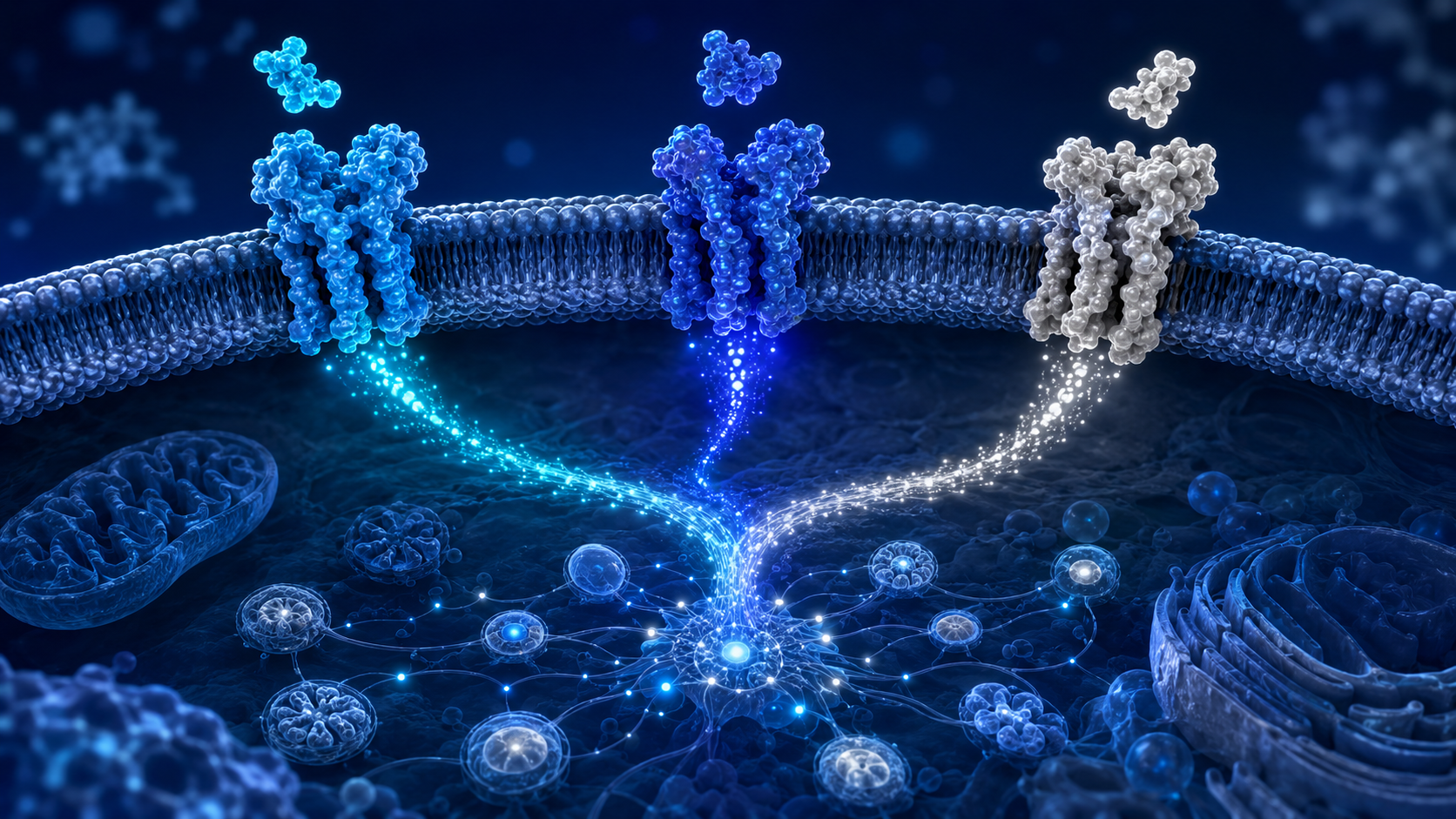
GLP-1, GIP, and Glucagon Pathway Research
GLP-1, GIP, and glucagon are peptide hormones involved in metabolic signaling. Their receptors influence overlapping but distinct pathways related to pancreatic function, nutrient handling, glucose regulation, appetite signaling, and energy expenditure.
Research into dual- and triple-receptor agonism examines whether one engineered molecule can activate multiple pathways in a coordinated manner. Although this field has advanced rapidly, much of the foundational evidence for triple agonism remains preclinical.
GLP-1 Biology
Glucagon-like peptide-1 is released primarily from intestinal L cells following nutrient exposure. It acts through the GLP-1 receptor, a G-protein-coupled receptor expressed in pancreatic, neural, gastrointestinal, and other tissues.
GLP-1 receptor activation has been studied for effects on:
- Glucose-dependent insulin secretion
- Glucagon regulation
- Gastric motility
- Satiety-related signaling
- Pancreatic-cell function
- Central nervous system pathways
The effects of GLP-1 signaling depend on glucose conditions, tissue type, receptor availability, and duration of activation.
GIP Biology
Glucose-dependent insulinotropic polypeptide is released from intestinal K cells. Its receptor is present in pancreatic cells as well as adipose, neural, bone, and other tissues.
GIP receptor research is complex because both agonism and antagonism have been investigated in metabolic models.
This apparent contradiction may reflect:
- Acute versus chronic signaling
- Differences among tissues
- Receptor desensitization
- Nutritional state
- Molecular bias
- Species differences
- Effects on neural circuits
- Differences among experimental compounds
The biological outcome cannot be predicted solely from whether a molecule is labeled a GIP receptor agonist or antagonist.
Glucagon Biology
Glucagon is produced primarily by pancreatic alpha cells. It acts through the glucagon receptor, with prominent effects in the liver.
Glucagon receptor signaling influences:
- Hepatic glucose production
- Amino-acid metabolism
- Lipid metabolism
- Energy expenditure
- Nutrient mobilization
- Pancreatic-liver communication
Glucagon is sometimes viewed only as a glucose-raising hormone, but its physiological role is broader.
When included in a multi-receptor molecule, glucagon activity must be balanced carefully. Excessive activity could oppose glucose control, while appropriately balanced activity may influence energy expenditure and nutrient metabolism.
What Is a Unimolecular Multi-Agonist?
A unimolecular multi-agonist is one engineered peptide capable of activating more than one receptor.
This differs from administering several independent molecules. A unimolecular compound has one pharmacokinetic profile, but its activity at each receptor can vary.
Researchers can adjust:
- Amino-acid sequence
- Receptor affinity
- Relative potency
- Molecular stability
- Signaling bias
- Duration
- Tissue distribution
Minor structural changes may substantially alter the biological profile.
Rationale for Dual Agonism
GLP-1/GIP dual agonists provided important evidence that coordinated activation of two incretin pathways could produce effects different from either pathway alone.
Research has examined:
- Pancreatic signaling
- Appetite-related neural pathways
- Adipose biology
- Receptor trafficking
- Glucose regulation
- Proteomic changes
- Sex-specific responses in animals
These findings established a foundation for broader multi-receptor designs.
However, results from one dual agonist cannot automatically be transferred to another molecule with a different potency ratio or signaling profile.
Rationale for Triple Agonism
Triple agonists add glucagon receptor activity to GLP-1 and GIP receptor signaling.
The proposed research rationale includes complementary functions:
- GLP-1 receptor activity contributes incretin and appetite-related signaling.
- GIP receptor activity may broaden pancreatic, adipose, and neural effects.
- Glucagon receptor activity may influence hepatic metabolism and energy expenditure.
The objective is not maximum activation of all three receptors. It is an experimentally balanced signaling profile.
An unbalanced molecule may produce very different outcomes from a compound with more evenly distributed receptor activity.
Preclinical Triagonist Research
A rationally designed monomeric triagonist was evaluated in rodent models of metabolic dysfunction. The researchers reported changes in body weight, glucose regulation, and other metabolic endpoints.
This study helped establish the concept of integrating GLP-1, GIP, and glucagon receptor activity into one molecular scaffold.
Subsequent preclinical research has evaluated optimized compounds with different receptor-potency profiles. These studies demonstrate that triagonism is not a single standardized mechanism. Each molecule requires independent characterization.
Rodent findings cannot be treated as established human outcomes.
Receptor Trafficking
G-protein-coupled receptors can continue signaling from different cellular locations. After activation, receptors may:
- Remain at the cell surface
- Internalize into endosomes
- Recycle to the membrane
- Undergo degradation
- Recruit different signaling proteins
Research comparing GLP-1 and GIP receptor agonists demonstrates that internalization, recycling, and signaling duration can vary between compounds.
Two molecules with similar binding potency may therefore produce different cellular responses.
Signaling Bias
A receptor can activate more than one intracellular pathway. An agonist may favor certain pathways over others, a concept known as signaling bias.
Relevant pathways may include:
- Cyclic AMP signaling
- Beta-arrestin recruitment
- Calcium-related signaling
- Kinase activation
- Receptor internalization
- Gene-expression changes
Signaling bias adds another layer of complexity to multi-receptor agonism. Researchers must characterize not only which receptors are activated, but how each receptor signals.
Neural-Circuit Research
GLP-1 and GIP receptors are expressed in neural circuits involved in nutrient sensing and appetite-related behavior.
Animal research suggests that long-acting GIP receptor agonists and GLP-1/GIP co-agonists can affect food intake and body weight through specific inhibitory GABAergic neurons.
These findings demonstrate that incretin biology extends beyond pancreatic signaling. However, neural-circuit results from rodents should not be generalized directly to humans.
Pancreatic Research
GLP-1 and GIP receptors both contribute to glucose-dependent insulin signaling. Researchers have proposed several models for how multi-receptor agonists may affect pancreatic cells.
Possible mechanisms include:
- Activation of different beta-cell populations
- Amplification of intracellular signaling
- Changes in receptor trafficking
- Effects on alpha-cell signaling
- Altered paracrine communication within pancreatic islets
These hypotheses remain active areas of investigation.
Proteomic Research
Proteomic studies analyze broad changes in proteins following receptor activation. In obese mouse models, GLP-1/GIP co-agonism produced proteomic changes distinct from those observed with individual mono-agonists.
Researchers identified changes involving metabolic, inflammatory, hepatic, and cardiovascular-associated protein pathways.
Proteomic associations do not by themselves establish functional outcomes. They can identify biomarkers and generate mechanistic hypotheses.
Research Limitations
Important limitations include:
- Much triple-agonist evidence remains preclinical.
- Compounds differ in receptor balance.
- Rodent metabolism differs from human metabolism.
- Receptor signaling varies among tissues.
- Long-term effects require further study.
- Results from dual agonists cannot substitute for triagonist evidence.
- Findings from one triagonist cannot be generalized to all compounds.
- Molecular bias and trafficking may change outcomes.
The field should be discussed as active research rather than a uniform clinical category.
Future Research Directions
Future studies may investigate:
- Optimal receptor-potency ratios
- Biased signaling
- Receptor trafficking
- Neural-circuit contributions
- Pancreatic-cell heterogeneity
- Hepatic amino-acid metabolism
- Sex-specific responses
- Long-term receptor regulation
- Biomarkers of pathway engagement
- Translation of animal findings to humans
Direct comparisons among molecular designs will be especially important.
Conclusion
GLP-1, GIP, and glucagon triple-receptor research integrates three metabolic signaling systems within a single molecular design. Preclinical findings support continued investigation of balanced multi-receptor activation, while receptor-trafficking studies demonstrate why molecular structure and signaling bias matter.
Evidence must be evaluated compound by compound. Animal research and findings involving dual agonists do not independently establish human outcomes for every triagonist.
These compounds are supplied strictly for qualified laboratory research and are not intended for human or animal consumption.
References
- Finan B, et al. A rationally designed monomeric peptide triagonist corrects obesity and diabetes in rodents. Nature Medicine. 2015. PubMed
- Knerr PJ, et al. Next-generation GLP-1/GIP/glucagon triple agonists in preclinical models. 2022. PubMed
- Knerr PJ, et al. Selection and progression of unimolecular agonists at GIP, GLP-1, and glucagon receptors. 2020. PubMed
- Novikoff A, et al. Spatiotemporal GLP-1 and GIP receptor signaling and trafficking. 2021. PubMed
- Liskiewicz A, et al. GIP regulates body weight and food intake through inhibitory GABAergic neurons. 2023. PubMed
- Sachs S, et al. Plasma proteome profiles of GLP-1/GIP co-agonism in obese mice. 2021. PubMed
- Willard FS, et al. Biased signaling at GIP and GLP-1 receptors. 2020. PubMed